
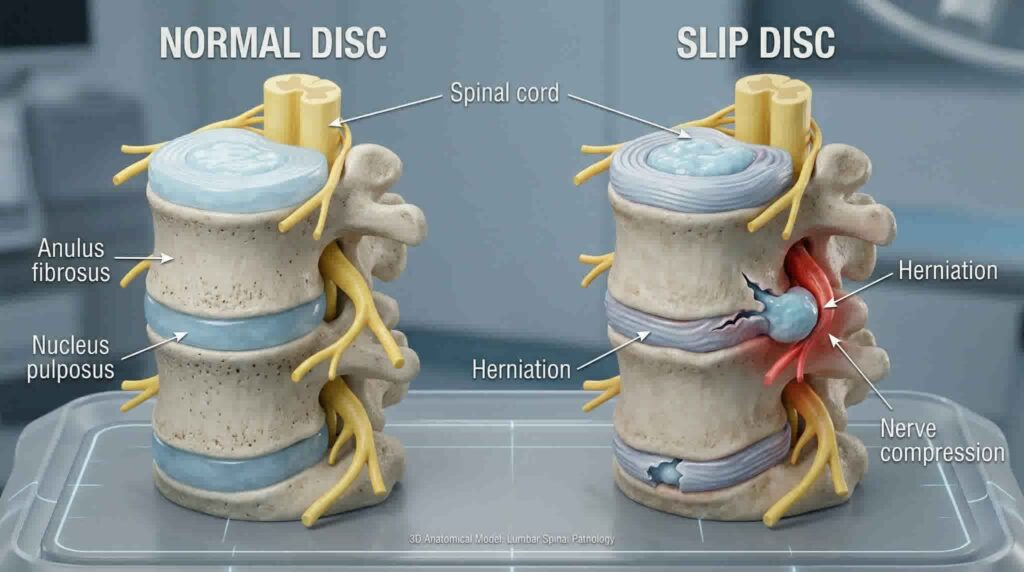
What is a slipped disc (Herniated Disc)?
Slip Disc Treatment, often interchanged with a herniated disc, describes a spinal condition where the soft nucleus inside a disc pushes outward through its tougher outer ring. This escape isn’t always dramatic, yet when it presses against nearby nerves, discomfort emerges—sometimes subtly, sometimes with piercing intensity.
The spine, a marvel of biological engineering, relies on discs as shock absorbers. When these cushions falter, even routine movement can feel like friction against fire.
Interestingly, the phrase “slipped disc” is somewhat misleading. The disc doesn’t literally slip; it distorts, bulges, or ruptures. This nuance matters when discussing slipped disc vs disc herniation, as both terms point toward similar structural disruption.
Slip Disc Causes and Risk Factors
A slip disc rarely arrives uninvited—it builds quietly, shaped by lifestyle and time.
Primary Causes
- Aging (Degeneration): With years, discs lose hydration and elasticity
- Improper lifting: Twisting while lifting a weight is a common trigger
- Sedentary routine: Weak muscles fail to support the spine
- Obesity: Extra weight intensifies spinal pressure
- Repetitive strain: Frequent bending or heavy work accelerates wear
Hidden Contributors
- Genetic predisposition (yes, slipped disc genetic links exist)
- Smoking, which reduces disc nutrition
- Poor posture during prolonged sitting
One might not notice the damage accumulating—until a sudden bend or lift awakens sharp pain.
Slip Disc Symptoms and Early Warning Signs
Symptoms vary widely. Some feel mild irritation; others experience debilitating nerve pain.
Common Slipped Disc Symptoms
- Persistent slipped disc back pain
- Radiating pain down the leg (sciatica)
- Tingling or numbness
- Muscle weakness
- Difficulty standing or walking
Early Signs to Watch
- Stiffness in lower back or neck
- Pain after long sitting hours
- Sharp discomfort when bending
If ignored, these signals may evolve into slip disc nerve compression, affecting mobility.
Slip Disc vs Disc Bulge vs Herniated Disc
Understanding distinctions helps avoid confusion.
| Condition | Description |
|---|---|
| Slip Disc | General term for disc displacement |
| Disc Bulge | Disc protrudes, but outer layer intact |
| Herniated Disc | Inner material leaks out |
While all three may cause pain, the severity differs. A slipped disc bulge might remain silent, whereas a herniation often irritates nerves.
Slip Disc Diagnosis: MRI, X-ray & Tests
Diagnosis isn’t guesswork—it’s structured and precise.
Common Diagnostic Tools
- MRI (Most reliable)
- X-ray (limited use; shows bones, not discs)
- Neurological examination
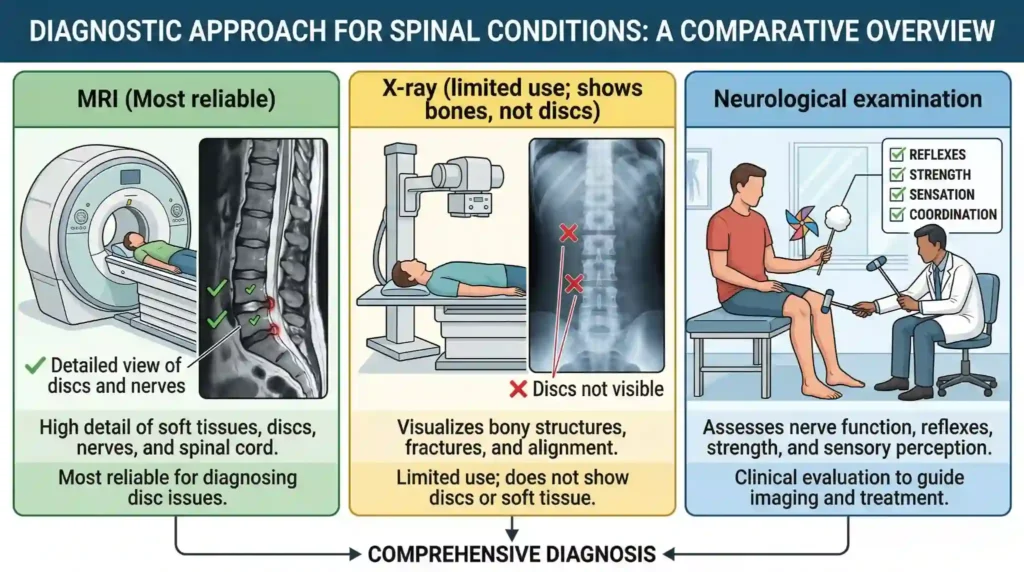
While many ask if a slipped disc can be seen on an X-ray, the answer is nuanced—X-rays reveal alignment but not disc tissue. MRI remains the gold standard.
Slip Disc L4 L5 and L5 S1 Explained
The lower spine bears the brunt of daily movement.
Why L4-L5 & L5-S1 Matter
- These segments endure maximum stress
- Most common sites for herniation
- Often linked with sciatica
Symptoms of L4-L5 Slip Disc
- Pain radiating to the thighs
- Weakness in the foot or ankle
Symptoms of L5-S1
- Pain extending to the heel or toes
- Difficulty standing on the toes
These conditions often require targeted slipped disc L4 L5 treatment or L5 S1 therapy.
Is Slip Disc Dangerous or Curable?
A pressing question: Is slip disc curable?
The answer isn’t black or white.
Reality Check
- Most cases improve without surgery
- Some require long-term management
- Severe nerve compression needs urgent care
While not always “curable” in the strictest sense, it is highly manageable—and often reversible with discipline.
Best Slip Disc Treatment Options
Non-Surgical Treatment
For most individuals, conservative care works wonders.
- Rest (short duration only)
- Pain-relief medications
- Heat and cold therapy
- Posture correction
Physiotherapy and Exercises
Movement is medicine—when done correctly.
- Core strengthening
- Stretching routines
- Guided physiotherapy
Slip Disc Treatment Without Surgery
Many prefer natural healing routes:
- Yoga therapy
- Lifestyle adjustments
- Ergonomic modifications
Walking, contrary to myth, often accelerates healing.
Slip Disc Surgery: When Is It Needed?
Surgery isn’t the first step—it’s the final resort.
Indications
- Persistent pain despite treatment
- Progressive weakness
- Loss of bladder or bowel control
Types of Surgery
- Microdiscectomy
- Endoscopic surgery
- Spinal fusion (rare cases)
Success rates are generally high when performed by experienced specialists.
Recovery Time and Healing Stages
Healing is not a sprint—it’s a measured journey.
Typical Timeline
| Stage | Duration |
|---|---|
| Acute Pain | 1–2 weeks |
| Improvement | 4–6 weeks |
| Full Recovery | 3–6 months |
Some cases may stretch longer, yet improvement is common with proper care.
What to Avoid in Slip Disc
Certain actions worsen the condition.
- Heavy lifting
- Prolonged sitting
- Sudden twisting
- High-impact workouts
Ignoring these can prolong recovery significantly.
Slip Disc Yoga and Lifestyle Changes
Yoga isn’t magic—but it’s remarkably effective.
Helpful Practices
- Gentle stretches
- Breathing exercises
- Core stability poses
Lifestyle Shifts
- Maintain a healthy weight
- Stay active
- Improve posture
Small changes compound into significant relief.
Choosing the Right Slip Disc Specialist
Expert care makes a measurable difference.
If you’re searching for a slipped disc doctor near me, consider:
Dr Nirmal Patil
Leading Orthopedic Spine Surgeons in Wakad, PCMC
📍 4th Floor, MI Commercials Building, Unit 401
Vishnu Dev Nagar, Wakad, Pimpri-Chinchwad, Pune – 411057
Known for precision-driven care, he offers advanced diagnosis and both surgical and non-surgical solutions tailored to patient needs.
🩺 Conditions Treated
At our spine care center, we diagnose and manage a wide spectrum of spinal disc disorders and nerve-related conditions, offering advanced care for both acute and chronic cases.
🔹 Slip Disc & Disc Disorders
- Slip disc (herniated disc)
- Slipped disc back pain
- Disc bulge and multiple disc bulge
- Disc herniation and disc prolapse
- Spinal disc problem and degenerative disc disease
🔹 Spine Level-Specific Conditions
- Slip disc L4 L5
- Slip disc L5 S1
- Lumbar disc herniation
- Cervical slipped disc (neck disc issues)
- Thoracic disc herniation
🔹 Pain & Symptom-Based Conditions
- Lower back pain due to slip disc
- Neck pain caused by slip disc
- Sciatica pain related to slip disc
- Nerve compression symptoms
- Leg pain due to slip disc
- Numbness in the leg from disc issues
- Tingling in the arms due to a cervical disc
🔹 Severe & Advanced Spine Conditions
- Severe slipped disc pain
- Chronic back pain due to disc problems
- Acute disc herniation
- Slipped disc causing difficulty in walking
- Advanced disc degeneration
🔹 Nerve & Spine-Related Disorders
- Nerve root compression
- Spinal nerve damage
- Pinched nerve in the spine
🔹 Comparative & Related Conditions
- Slip disc vs disc bulge
- Slip disc vs sciatica
- Slip disc vs muscle strain
- Slip disc vs spondylosis
- Slipped disc vs herniated disc
🔹 Patient-Specific Conditions
- Slipped disc in young adults
- Slipped disc in elderly patients
- Slipped disc during pregnancy
- Sports injury-related slipped disc
- Office workers’ back pain and disc issues
Frequently Asked Questions (FAQs)
1. Is a slipped disc the same as a herniated disc?
Yes, both terms are often used interchangeably, though medically, “herniated disc” is more accurate.
2. Can slip disc be cured without surgery?
Absolutely. Most cases improve with physiotherapy, rest, and lifestyle adjustments.
3. How long does slipped disc recovery take?
Typically 4–12 weeks, though some cases may take longer.
4. Is walking good for slip disc?
Yes, gentle walking improves blood flow and promotes healing.
5. What is the best sleeping position?
Sleeping on your back with knee support or on your side with a pillow between your legs works best.
6. Can sitting too much cause slip disc?
Yes, prolonged sitting increases pressure on spinal discs and can trigger or worsen symptoms.
Conclusion
Slip disc treatment is not a one-size-fits-all equation—it’s a layered, evolving process. From early diagnosis to disciplined rehabilitation, each step shapes recovery.
Dr Nirmal Patil is a leading spine specialist and orthopedic expert in Wakad, Pune, widely recognized for advanced slipped disc treatment and comprehensive care for back pain, neck pain, and disc-related disorders. With extensive experience in managing conditions like slipped disc (herniated disc), disc bulge, and L4-L5 or L5-S1 spine issues, he provides both non-surgical and minimally invasive surgical solutions tailored to each patient. Practicing at his clinic in Pimpri-Chinchwad (PCMC), Dr Patil combines precise diagnosis, including MRI-based evaluation, with modern physiotherapy and spine care techniques to ensure faster recovery and long-term relief. Patients searching for a trusted slipped disc doctor near Wakad or PCMC rely on his expertise for effective, personalized, and result-driven spine treatment.
Post-Article Message:
If you found this guide helpful, consider sharing it or consulting a qualified spine specialist for personalized care.